Building a platform where remote workers can work anywhere and actually belong somewhere
Founding Product Designer · 0→1 · Concept to live pilot in 6 weeks · Solo
Post-pilot feedback validated the design decisions. Both operators said the product was easy to understand without too many steps. One works with multiple MNCs - he said the UI and experience stood out from a functionality perspective and other mentioned how easy it was to use.
Overview
The freedom to work anywhere. The community to make it worth it.
Remote work solved the location problem. It didn't solve the loneliness that came after.
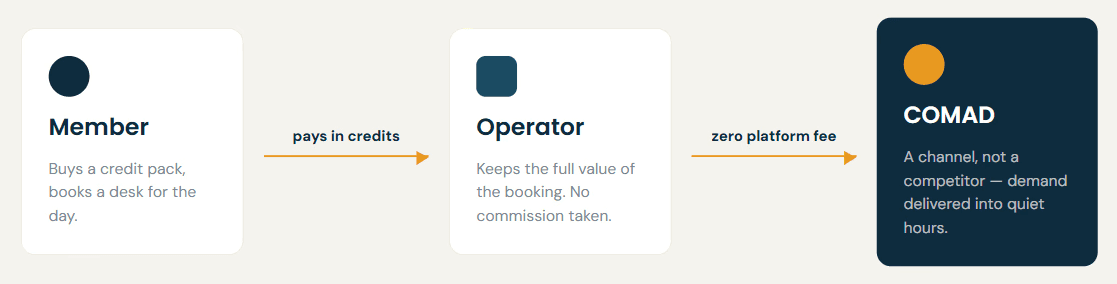
COMAD is a two-sided platform: members book flexible workspaces by the day using credits, choosing a different space every time without being tied to one. Operators fill desks that would otherwise sit empty.
The Gap
Coworking today: £300/month for a membership you'll feel guilty about, or a café hoping nobody asks you to leave.
Nine products. All solving half the problem.
No platform did all three. That was the product.

Research
Two Mental Models, One Platform
Two completely different people. One platform. Zero shortcuts.

Remote workers & Freelancers
Trust before they'd book somewhere new.
Social proof, vibe signal, a booking flow under 30 seconds
Belonging. Showing up somewhere alone is the friction.
Operators
Proof this wouldn't be more work than it's worth
One question answered in under ten seconds every morning
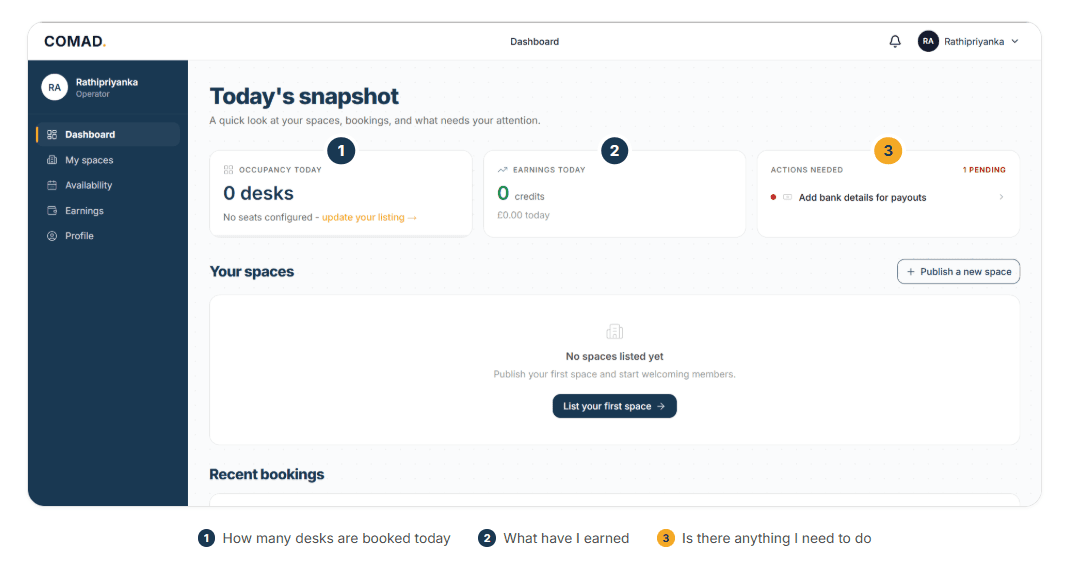
how full am I, what have I earned, do I need to do anything.
Where they conflicted and how I resolved it:
Availability
Members want to see maximum green dates. Operators need to restrict without it feeling punishing.
Operators get complete control.
Pricing
Members want transparency. Operators don't want direct price comparison
Credit Model. The abstraction is honest about cost but protects operator pricing from direct comparison.
Key Decisions
The decisions that shaped the product and what I didn't choose
1.
Credits over cash → flexibility feels like a product, not a transaction
Monthly subscription rejected - contradicts the core promise of flexibility.
Straight cash rejected - every booking feels transactional, enables direct price comparison.
Credits create pre-commitment (you bought them, you'll use them) and protect operator pricing behind an abstraction layer.

2.
Real-time availability over approval-based booking → waiting kills momentum
The emotional window for "I want to work somewhere different today" closes fast. If a member has to wait for
operator approval, that window has already closed.
Real-time means the booking either works or it doesn't. No limbo.
3.
Interest circles over open community → shared context before message one
Open community rejected - connecting strangers with no shared context creates moderation problems at scale.
Location groups rejected - they create a notice board, not belonging.
Identity-based circles work because designers talking to designers already have something before the first message.

4.
Three-question dashboard over analytics → what operators actually needed at this stage
An operator with one listed space and ten bookings doesn't need a revenue trend chart. They need: how many desks are booked today, what have I earned, is there anything I need to do. Every other element got cut.
Post-pilot feedback validated this. Both operators said the product was easy to understand without too many steps. One works with multiple MNCs - he said the UI and experience stood out from a functionality perspective.
Building With AI
I write prompts. AI builds screens and logic together.
The thinking happens before the prompt.
Designing for AI-assisted development changed the process fundamentally. I wasn't producing screens for a developer to interpret. I was producing thinking for a tool that would build logic and interface simultaneously. The quality of what came out was directly proportional to the quality of what went in.
What Broke
What actually happened when real people started using it
Three things failed when the pilot went live. None were edge cases, they were core flows that worked in solo testing and broke the moment two real users were on the platform at the same time.

Impact
Technology pilot, not market validation. Here's what the numbers mean.
The platform works. Credits flow, bookings happen, real-time connections function, emails send, the admin panel gives the founder full control. Market validation starts now. The one number I'm watching: do members book a second time.

Explore more

Members want to see maximum green dates. Operators need to restrict without it feeling punishing.